In everyday speech, people often confuse bulrush, cattail, and reed, although these are distinct plants. True bulrush belongs to the sedge family and has its own characteristic features that distinguish it from cattail and reed.
Bulrush
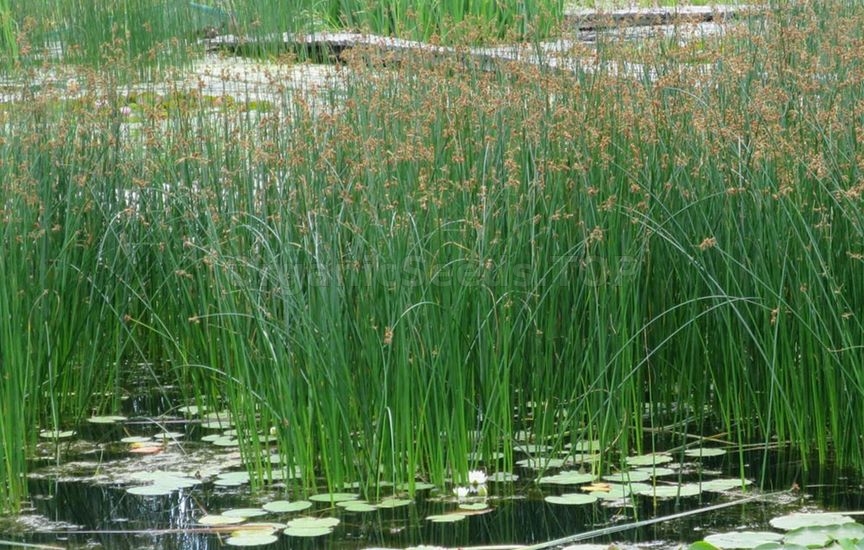
Bulrush (Scirpus) is a perennial wetland plant that can grow up to 3.5 m tall. Its stem is cylindrical or triangular, smooth and shiny.
Key features of bulrush:
- straight hollow stem with nodes;
- terminal panicle-like inflorescence, reddish-brown or greenish-black;
- fruit is a three-angled nutlet;
- large rhizome.
Bulrush helps purify polluted waters and is used by humans to produce paper, alcohol, packaging materials, and in tropical regions even lightweight housing.
There are 22 species of bulrush in Eurasia, the most common being the lake bulrush and the forest bulrush.
- Lake bulrush reaches 1–2.5 m, forms dense thickets thanks to creeping rhizomes, and blooms in July–August. It has a loose panicle up to 8 cm and gray three-angled nutlets.
- Forest bulrush is shorter, up to 140 cm. It has flat leaves up to 2 cm wide, a large ovate inflorescence up to 20 cm, small spikelets, and greenish-black scales. It flowers in June–July and fruits in August.
Cattail
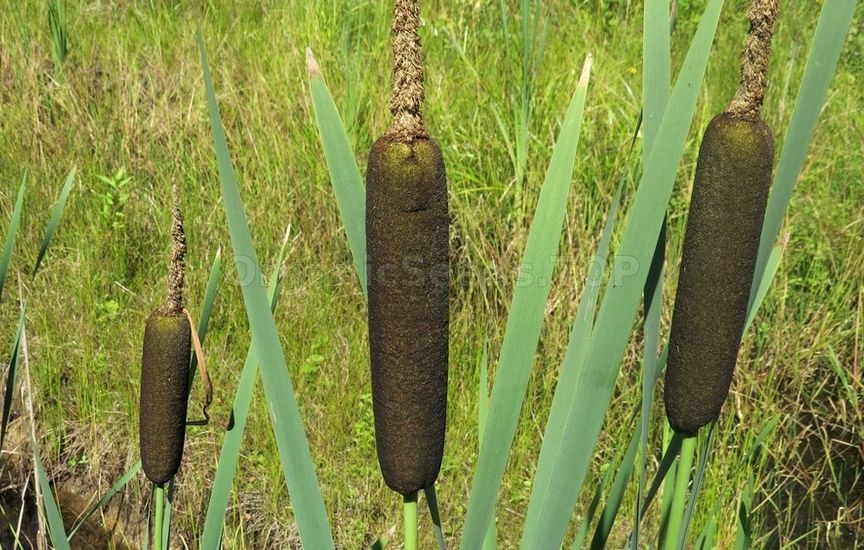
Cattail (Typha) grows up to 2 m tall, with thick succulent stems and a powerful rhizome that forms wide colonies.
The main feature of cattail is its spike-like inflorescence:
- the lower part consists of female flowers;
- the upper part consists of male flowers;
- the spikes retain their shape until spring, then disperse into fluffy seeds.
Leaves are tough, strap-like, about 2 cm wide. In Ukraine and Russia, the most common species are broadleaf cattail and narrowleaf cattail.
Uses of cattail:
- dry stems and spikes for fire-starting;
- fluff for stuffing mattresses and pillows;
- raw material for felt and paper;
- used as fuel in treeless areas.
Common Reed
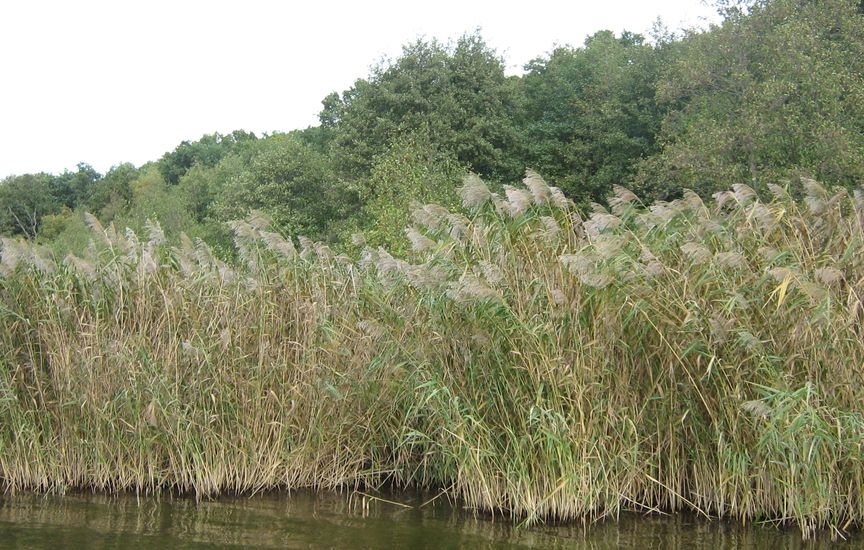
Common reed (Phragmites australis) is a tall grass often mistakenly called bulrush. It should not be confused with sugarcane.
Features of common reed:
- height 1–4 m;
- long, stiff, gray-green leaves;
- large fluffy panicles up to 40 cm, usually leaning in one direction;
- blooms in July.
Reed forms vast, impenetrable thickets known as “plavni,” which historically served as shelter for animals and people.
Uses of reed:
- stems for weaving furniture, baskets, and roofing;
- fuel and cellulose production;
- rhizomes rich in starch (up to 50%), protein (up to 5%), and fiber (up to 32%).
In times of famine, rhizomes were dried, ground into flour, and mixed with wheat or rye flour, though excessive fiber caused health problems.
Medicinal properties: reed preparations have antipyretic, diuretic, sudorific, anti-inflammatory, and vitamin effects.
Conclusion
- Bulrush — sedge family plant with panicle inflorescence and three-angled nutlet.
- Cattail — plant with brown cylindrical spikes and tough strap-like leaves.
- Common reed — tall grass with fluffy panicles forming dense thickets.
These plants may look similar but differ in structure, family, and practical use.