ABOUT US     FAQ     CONTACTS

Cabbage until spring: how to harvest, prepare and store heads properly

Growing a rich cabbage harvest is only half the battle. To keep the heads firm and juicy until spring, they need to be harvested on time, properly prepared for storage, and provided with suitable conditions in a cellar or another room.
Cabbage until spring: how to harvest, prepare and store heads properly

Mistakes at any of these stages can lead to wilting or rotting of the vegetables.
 

When to harvest cabbage from the garden

One of the main secrets of long cabbage storage lies in the correct timing of harvesting. If you cut the heads too early, while the weather is still warm, they will quickly wilt in the cellar due to intense moisture evaporation. If you delay harvesting and allow severe freezing, the cabbage will become soft, acquire an unpleasant taste, and begin to rot from the inside.
Cabbage until spring: how to harvest, prepare and store heads properly

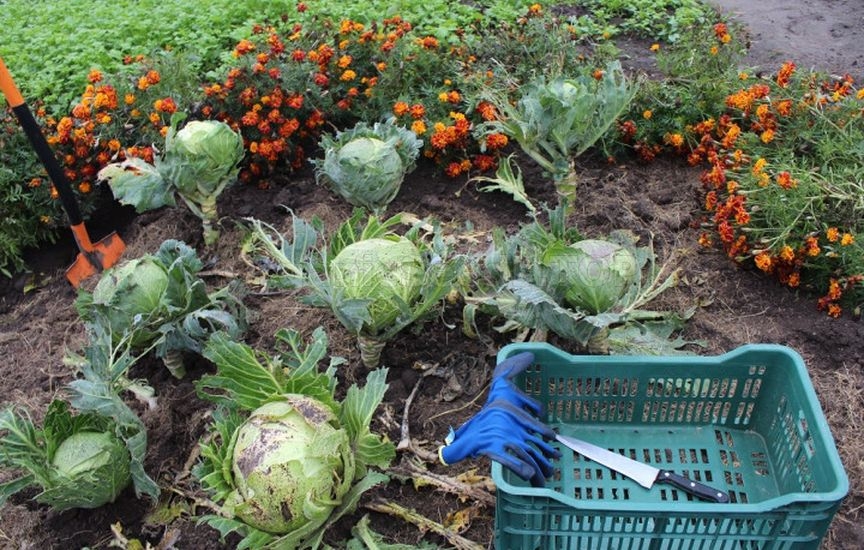
Harvest timing depends on the variety, weather, and purpose of the crop. Early cabbage is usually grown for quick consumption. It is not intended for long storage, because it begins to spoil quickly. The heads are harvested in summer, selectively, as they form. Mid-season cabbage can last longer, several months, but it is desirable to cut it before long autumn rains so that the heads do not crack.

Only late-ripening cabbage with a denser structure, tougher leaves, and a higher dry matter content is suitable for long winter storage. With timely harvesting and proper preparation, heads of late varieties remain in a cold room without loss of quality until the end of winter and even until spring.

The optimal time for harvesting late cabbage in the central belt comes at the end of October. It is important to catch the moment when the heads have already formed but serious frosts have not yet begun. Light minus (down to –2°C) cabbage will survive. Moreover, it only benefits it: sugars in the leaves turn into starch, excess bitterness goes away, and the taste becomes softer and sweeter. However, if you miss this moment and let the heads freeze through, they will store poorly.

It is better to harvest cabbage in dry weather, closer to evening, so that the heads do not heat up in the sun. If there is a rainy autumn, wait for a day without precipitation so that the soil and the plants themselves dry out a little. Heads harvested in wet weather contain excess moisture, which can lead to the development of fungal diseases during the dormant period.

How to determine cabbage readiness for harvesting by the head? The head should be firm to the touch, the upper leaves should be glossy, not matte. If you cut the head, the stalk inside should be light, without voids.

Another sign: cabbage stops increasing in size. If you see that new leaves are not appearing and the head has gained the mass characteristic of the variety, it is time to harvest.
 

How to harvest cabbage properly
Cabbage until spring: how to harvest, prepare and store heads properly

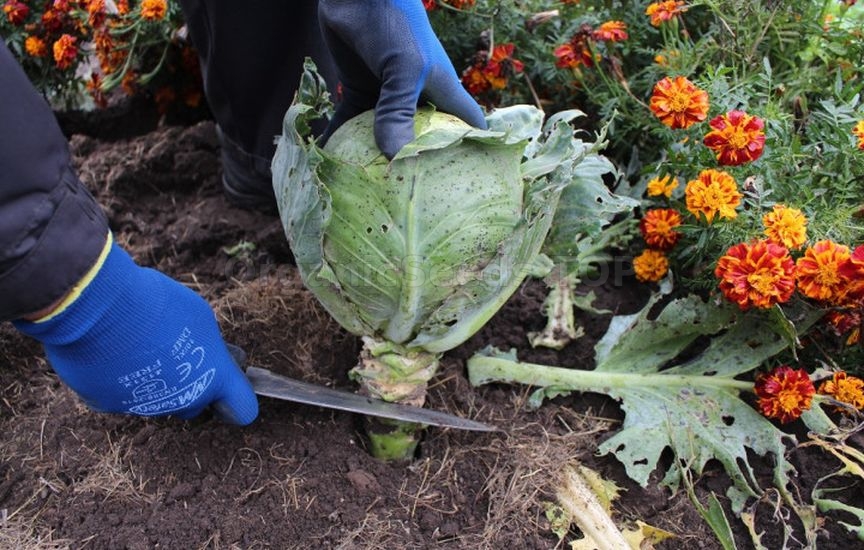
For harvesting, prepare a sharp knife with a long blade. First remove the lower leaves that will interfere with cutting the heads. After that, cut the cabbage, leaving 3–4 cm of stalk.

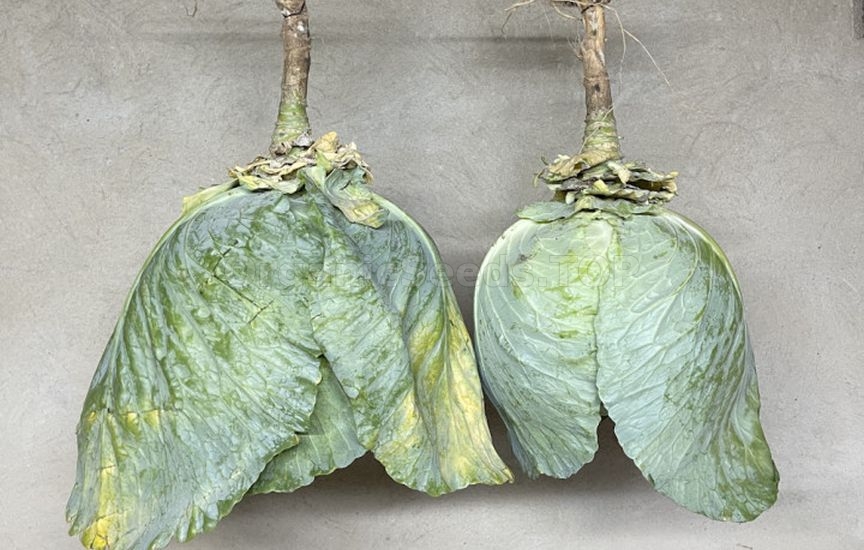
Some gardeners store cabbage in a suspended state (more on this below). In this case, it is harvested together with the root. The heads are carefully dug up with a shovel or pitchfork and removed from the soil by hand.

Immediately after cutting, remove a few covering leaves, preferably no more than two or three layers. The upper covering leaves are the head’s natural protection. They protect the head from mechanical damage, drying out, and contact with possible sources of infection, so only damaged, yellowed, or clearly diseased leaves should be removed.

When harvesting, do not throw the vegetables on the ground or stack them in tall piles: bruises and cracks shorten the storage life of the crop.
 

Which heads are suitable for storage until spring
Cabbage until spring: how to harvest, prepare and store heads properly

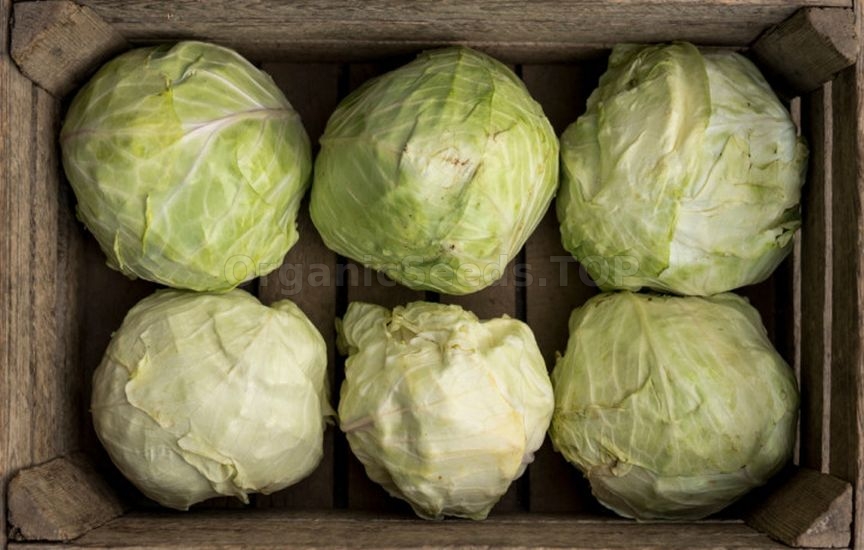
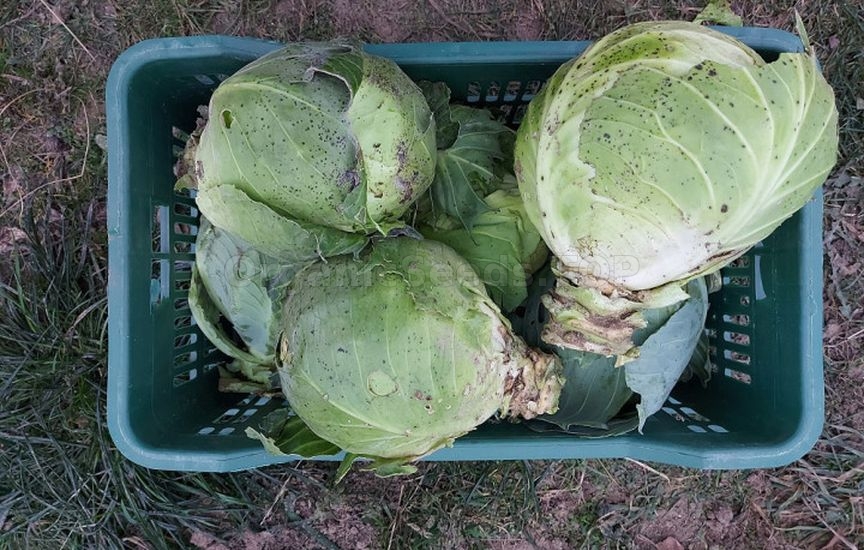
After harvesting, the cabbage is initially sorted. Even if you grow plants of the same variety, the heads will still differ in density, size, and other parameters. All heads are carefully examined from all sides. For long storage, select medium or large heads that are absolutely healthy, dense, heavy, without signs of disease, traces of pest damage, or cracks. Too loose specimens lose moisture faster and often begin to spoil earlier.

If the head is soft or unripe, has suffered from caterpillars or slugs, has suspicious spots or traces of rot, it is better to use it immediately for cooking or send it for processing. The same applies to overgrown and cracked heads. Even if the defect seems small, such a head should not be placed for long storage next to healthy vegetables. Also pay attention to an unpleasant smell: it may indicate the beginning of rotting of the head from the inside.

After sorting, the cabbage needs to be dried. Direct sunlight during this period is undesirable, because the leaves quickly wilt from it. Lay the heads in one layer in a cool, dry, ventilated room (barn, attic, under a canopy) for 1–2 days. During this time, the upper leaves will become parchment-like to the touch, and the cuts on the stalks will dry out and become covered with a protective crust.

Before storing, cabbage is not washed. Water washes away the natural waxy coating that protects the head from fungi. If the heads are very dirty, simply wipe them with a dry cloth.


Conditions for storing cabbage

Cabbage until spring: how to harvest, prepare and store heads properly

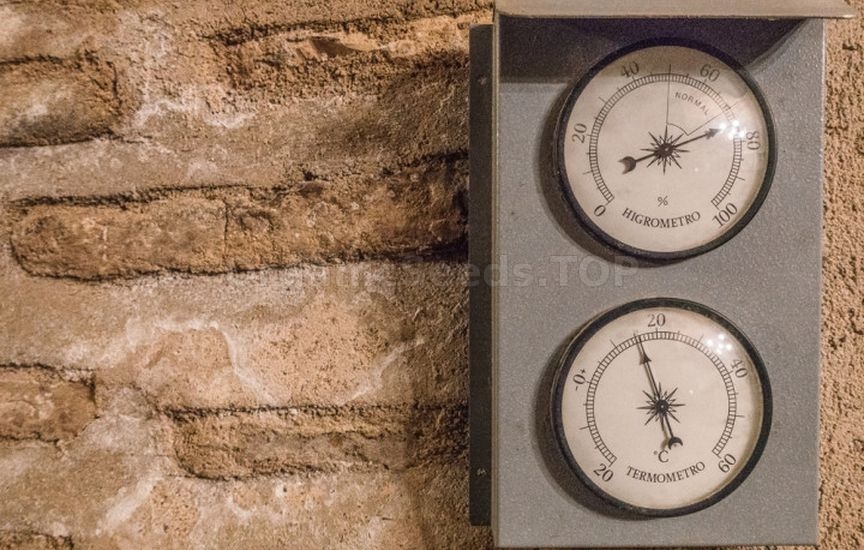
For long-term storage of white cabbage, cold, high relative humidity, and good ventilation are needed. The optimal temperature is usually around 0–1°C.

If the cellar is too warm (temperature above 4–5°C), cabbage loses moisture faster and begins to sprout. In addition, in a warm room the risk of fungal diseases increases, which significantly shortens the storage life of the crop.

Air humidity is also important. The optimal relative humidity in the place where cabbage is stored is about 90–95%. In a dry room, the outer leaves quickly lose moisture and wrinkle. Too high humidity, when condensation appears on the heads and water droplets form on the ceiling and walls, creates conditions for the development of mold and bacterial rots.

Another important nuance. It is undesirable to store cabbage next to apples and other fruits that release ethylene: this gas can accelerate the aging of plant tissues. Also, do not place the heads next to heating devices, potatoes in wet piles, or vegetables that have already begun to rot.
 

Methods of storing fresh cabbage

Cabbage until spring: how to harvest, prepare and store heads properly

There are several time-tested ways to preserve cabbage until spring. Let’s focus on the most popular.

On shelves or racks

This is one of the most convenient ways to store cabbage. The heads are laid out in the cellar in one layer, stalk up, on wooden shelves, leaving small gaps between them for air circulation. The racks are pre-disinfected and dried. It is desirable that the vegetables do not touch not only each other but also the walls of the cellar.

Periodically, about once a month, the cabbage is inspected and dried or damaged upper leaves are removed. In addition, regular inspection allows you to quickly notice the first signs of spoilage and remove the problematic specimen in time.

In boxes

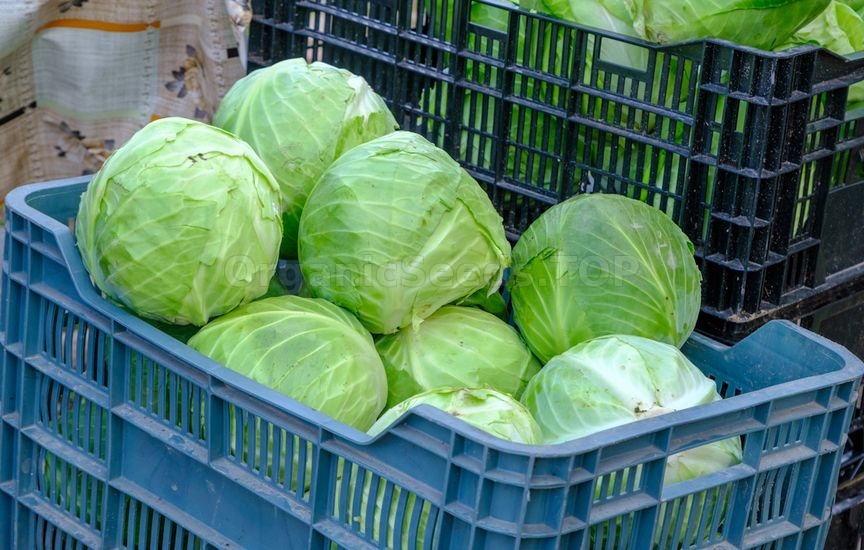
Wooden or plastic boxes are convenient when there is a large harvest and it needs to be placed compactly. It is important that the container has ventilation holes. The heads are laid loosely, without compacting or filling the box to the top.

With this method, it is more difficult to control the condition of the vegetables, especially those heads that are in the middle or at the bottom of the box. If possible, it is better to use several shallow boxes than one large one filled to the brim.

In sand

Some gardeners store cabbage in sand. A layer of slightly moist clean river sand about 10 cm thick is poured into deep wooden boxes. After that, the heads are laid stalk down so that they do not touch each other, and completely covered with sand. Sand slows the evaporation of moisture from the head and protects it from temperature fluctuations. Instead of sand, dry clay is sometimes used: each head is dipped in a thick clay mash, dried until a strong crust forms, and stacked on shelves. The clay shell protects cabbage from drying out and pests.

Cabbage until spring: how to harvest, prepare and store heads properly

In suspended form

If the cabbage was harvested with roots, the heads can be hung by the roots from a crossbar. In this case, the vegetables do not touch the floor or each other, and they are convenient to inspect. There should be enough space between the suspended heads.

In plastic wrap

In city apartment conditions, when there is no cellar, it is much harder to keep cabbage fresh, but it is possible. For this, food polyethylene wrap is used. Each head is tightly wrapped in several layers of plastic wrap, trying to drive out all the air. It reduces moisture loss and helps preserve the elasticity of the outer leaves longer. It is important that the surface of the head is dry. Before wrapping, damaged leaves must be removed from the head. Cabbage in wrap stores well on a non-freezing loggia and in the refrigerator.

However, remember that this method is suitable only for absolutely healthy vegetables. If you wrap wet cabbage or a head with an unnoticed damage, moisture may accumulate under the wrap and rot may develop. From time to time check the packaging: if condensation or an unpleasant smell appears, the head needs to be unwrapped and inspected.

In the refrigerator or on the balcony

In an ordinary refrigerator, whole heads can be stored for several weeks, sometimes longer, if a suitable temperature is maintained and the leaves do not dry out. For this, the cabbage is placed in the vegetable compartment, using a bag if necessary. Do not tightly close a wet head.

On an insulated balcony, cabbage can be stored longer than in an apartment, but only at a stable temperature around zero. In frosts, balcony conditions become unpredictable: vegetables may freeze at night and thaw during the day. After such a cycle, watery, darkened areas appear on the leaves, which quickly spoil. If the temperature on the balcony regularly drops below zero, it is better to move the harvest to a more reliable place.

To preserve cabbage until spring, choose late varieties, harvest dense healthy heads before severe frosts, handle them carefully, and store them in suitable conditions. During the winter, regularly, about once every two to three weeks, check the heads, and with increased humidity, unstable temperature, or the appearance of the first signs of spoilage — more often. And then the harvest you grew yourself will be on your table until spring.


You may need:

  • Vegetable seeds

  • Cabbage seeds

  • Organic fertilizers


  • Category: Vegetables | Rating: 0.0/0
    Added by: Yaroslav Gardener - Any content of this site can be used for noncommercial purpose only with active link to the original source - © 2026 ORGANICseeds.TOP

    Similar Articles:


    Total comments: 0
    Name *:
    Email *:
    Код *: