
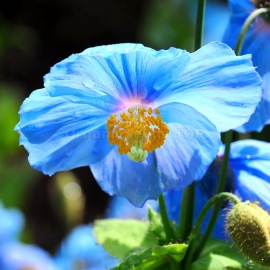


Organic Blue poppy seeds
1.14 €
What a delightful plant for cool summer climates! Plant poppy seeds—a prized garden flower.
-
Blue Poppy
Is an annual herbaceous plant, a species of the genus Papaver in the poppy family (Papaveraceae). This variety produces seed capsules that do not spontaneously release their seeds. The seeds are bluish in color. They are widely used in the baking industry, sprinkled on rolls, cookies, and pastries, and also pressed for oil.
Poppies require little care. They are sun‑loving, cold‑resistant, and undemanding regarding soil. Seeds are sown directly outdoors at the end of April or beginning of May. Germination occurs in 7–12 days; seedlings are thinned to 20–25 cm spacing. Plants do not tolerate transplanting well. Seeds can be sown in several batches every two weeks to extend the flowering season. Removing faded flowers prolongs blooming. Fertilization with mineral and organic nutrients enhances leaf color, flower size, and brightness. In the wild, it grows in the Mediterranean region. Stems are weakly branched, erect, bluish‑green with a waxy coating, up to 80 cm tall. Leaves vary from narrow to broad oblong at the base, elliptic on the stem, and ovate or triangular at the top, often crinkled.
Flowers are solitary on long stalks, simple or double, 9–12 cm in diameter, in shades of white, pink, red, purple, lilac, sometimes with spots at the petal base. They open early in the morning and drop petals by evening. Blooming occurs in June–July for 25–30 days. The fruit is a spherical capsule. Cultivated since 1597. Seeds are used in baking and for oil extraction. Capsules can also yield narcotic substances such as opium and morphine, so cultivation is restricted in many regions. As ornamentals, double‑flowered forms are valued, with blooms up to 15 cm across. Varieties include laciniata (fringed petals) and paeoniflorum (peony‑like flowers). When sown early in spring, plants flower in 1.5–2 months. Successive sowings every two weeks prolong flowering throughout summer. Though flowering is brief, the vivid blooms dominate the garden when open, creating a striking display.