
 EXCLUSIVE


Chinese Yam (Dioscorea Opposita) - Organic Seeds
4.97 €
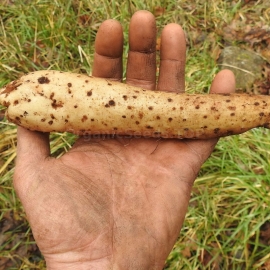
Chinese mountain yam is one of the few tubers grown commercially in China and used extensively as a source of starch. Until recently this species was used only as an ornamental in the U.S, for the sweet smelling cinnamon like blossoms.
-
Organic Chinese Yam Seeds (Dioscorea Opposita)
Chinese mountain yam is one of the few tubers grown commercially in China and used extensively as a source of starch. Until recently this species was used only as an ornamental in the U.S, for the sweet smelling cinnamon like blossoms and rarely thought of as a delicious tuber.
Not so much anymore where people are trying to find a perennial potato like substitute with less horticultural issues. Mountain yam also produces aerial tubers which grow along the vine as it grows up to 15 ft. tall or more. These tubers will reach up to 1/2 inch in size and can be picked and added to soups and stews. If the tubers are left on, they will drop to the ground and freeze to mush in the winter rarely spreading beyond the planting.
The in ground tubers are best harvested in 1-2 years. After that they seem to break down here in Michigan. They are great stir fried in ghee or sesame oil and are easily digestible. You can also grow them to enormous size reaching 5-10 lbs each. This species is edible and should not to be confused with the poisonous species found in Florida or the indigenous North American species which are also not edible known for their steroidal properties.
How to Grow
An easily grown plant, succeeding in a fertile well-drained soil in a sunny position or light shade, though it is best in full sun. Plants are hardy to at least -18°C. This species of yam is much cultivated in China for its edible root which can be up to 1 metre long. It has a great potential to be a commercial crop in Britain, though a satisfactory method of harvesting the root needs to be found.
Plants take 3-4 years to reach full maturity, though one year roots of well grown plants can weigh more than 500g. There are many cultivated forms with different root shapes in China and Japan. The yam is a climbing plant that supports itself by twining around the branches of other plants. It can be grown successfully into small bushes or, perhaps simpler when being grown as a root crop, it can be grown up a frame in a similar manner to growing runner beans.
Plants produce tubercles (small tubers that are formed in the leaf axils of the stems), and can be propagated by this means. The small white flowers have a pleasant scent of cinnamon. There is some confusion over the correct name for this species. One report says that D. batatas is an invalid name that is often erroneously applied to two distinct species D. opposita and D. japonica. The Flora of China accepts D. batatas as a synonym for D. polystachya. Dioecious. Male and female plants must be grown if seed is required.