
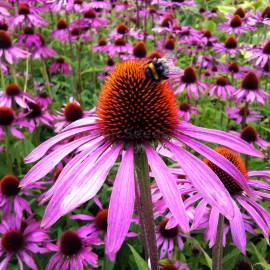


«Purple King» - Echinacea purpurea Seeds
1.14 €
Easily grown in average, dry to medium, well-drained soil in full sun to part shade. Best in full sun. An adaptable plant that is tolerant of drought, heat, humidity and poor soil. Divide clumps when they become overcrowded (about every 4 years).
-
Echinacea purpurea «Purple King»
Easily grown in average, dry to medium, well-drained soil in full sun to part shade. Best in full sun. An adaptable plant that is tolerant of drought, heat, humidity and poor soil.
Divide clumps when they become overcrowded (about every 4 years). Plants usually rebloom without deadheading, however prompt removal of spent flowers improves general appearance. Freely self-seeds if at least some of the seed heads are left in place.
Purple Coneflowers are quintessential prairie plants. They are hardy, drought-tolerant, long-blooming, and are being cultivated in an ever-widening range of colors. It's hard to find a garden without at least one variety. Echinacea is a native North American genus with about 10 species. Not all make great garden plants. Echinacea purpurea is by far the most popular coneflower.
It has a more fibrous root system, rather than the long tap root and woody crown found in other wilder species, and is more adaptable to garden conditions and more forgiving of dividing and transplanting.
Flowers: Coneflower's daisy-like flower is actually made up of several small flowers. The petals are sterile and are there to lure insects toward the many fertile flowers in the central disk or cone. These flowers are rich in nectar and very popular with both bees and butterflies.
Flowers used to only be some shade of purple or lavender, with a dark center cone. Much hybridization has been taking place and you can now find petal colors ranging from white to green through yellow, orange and deep reds.
The common name "coneflower" refers to the way the petals angle backward, away from the center, forming a cone.
Foliage: Growth starts with a clump of basal leaves, which eventually send up flower stems in mid-summer.
The leaf shape depends on the variety. Many have oval leaves with a wide base, but some from dry, western areas often have narrow leaves.