
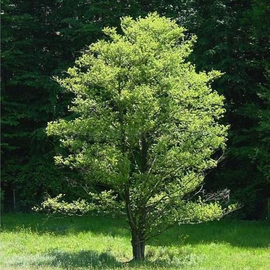
 NEW
NEW


Organic Grey Alder Seeds (Alnus incana)
1.14 €
Cone-shaped, deciduous tree, in adulthood can reach 10 m in height and up to 5 m in width, is used for alley plantings, hedges or forest plantings, resistant to pollution.
-
Grey alder, tag alder or speckled alder / Alnus incana
The culture belongs to woody plants from the genus Alder, family Betulaceae. It is a conical, deciduous tree that can reach a height of up to 20 meters. But in many cases, alder forms as a shrub, with a narrow-ovoid crown. The diameter of the trunk of the plant is up to 50 centimeters.
The trunk is rarely straight – most plants have a considerable number of depressions and bumps. The plant grows quickly only in the first 10–15 years. Older shrubs or trees slow down growth. Alder lives about 50–60 years (but specimens are known that reached 100 years).
The root system of alder is superficial, lying mainly in the upper soil layer at a depth of 10 to 20 centimeters. The color of the bark is light gray. The bark is smooth, without a cork layer. Shoots are initially greenish, but with age become brown or blackish-gray. Shoots are covered with gray pubescence.
Leaves on the plant are arranged in three rows. The characteristic of leaf arrangement is alternation. The shape of the leaves is oval, oval-lanceolate or ovate-rounded. Leaf length is about 10 centimeters, width from 3.5 to 7 centimeters. Leaf color is green, underneath grayish-white and pubescent.
The plant bears fruit annually with obovoid nuts, which have membranous wings. Fruits ripen in cones.
Annual growth is about 30–50 cm. At the end of winter and beginning of spring appear yellow-brown male catkins before leaf unfolding, and in summer – ovate fruits.
It grows best in river valleys, on moist and fertile soils. Prefers sun, partial shade. Frost resistance is very high (zone – 2a).
Application in landscape:
Avenue plantings, hedges or forest plantations. Resistant to pollution and sometimes used on waste dumps as a reclamation species and as a precursor for subsequent forest plantings. Valued for wood and medicinal properties.
Planting and care of alder
For planting the plant, it is necessary to choose the right place. This will not be difficult, since alder is the least demanding of ornamental plants. It can be placed even in shade – and the tree will not lose its decorative effect. But if you want to get a neat and healthy plant, still plant the seedling in a well-lit place.
The soil for planting alder should be mixed with fertile mixture. It is also recommended to pour a glass of slaked lime into each planting hole.
A year after planting, alder should be fertilized with special mineral fertilizers.
The main rule of successful cultivation of the plant is timely and regular watering of young plantings.
It is difficult to find a plant as undemanding in care as alder. The main care measure, specialists determine, is abundant watering during heat and drought. The tree rarely needs fertilization – alder is remarkable in that it enriches the soil with useful substances itself.
After watering, the soil should be well loosened so that it does not compact. The trunk circle of the plant should be constantly mulched with peat, chips or ordinary grass. The optimal mulch layer is 5 centimeters.
When growing alder, it is important to timely remove young shoots growing from the roots – they can clutter the site.
With this product buy
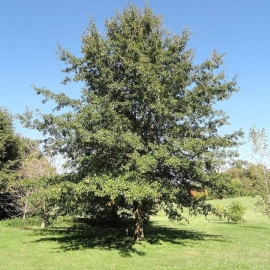
2.00 €
Deciduous tree up to 30m tall, straight trunk with a pyramidal crown, dark green shiny narrow oval leaves with a rich autumn color, differs from most other oaks in leaves that form like laurel.
Product code: 12449
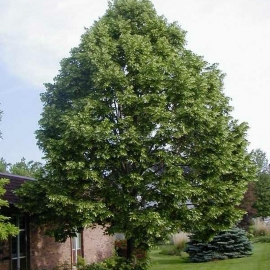
1.14 €
Deciduous tree, reaching a height of 20 - 35 (up to 45) meters with a trunk diameter of up to 1.2 meters, spreading crown, branches often drooping, flowering occurs at the beginning or middle of summer, the main pollinators are bees.
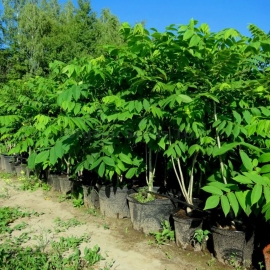
3.00 €
A tall plantation with a powerful trunk, medicinal leaves and tasty, healthy fruits, on the site the tree grows up to 10 meters in height, the culture is unpretentious, it will develop well in both loamy and sandy soil.
Product code: 15650
1.50 €
A herbaceous perennial plant-liana, the height of which varies from 50 to 90 cm, the rhizome is creeping, the stem of the birthwort is erect, slightly twisting, branches rarely, of a light green hue.